





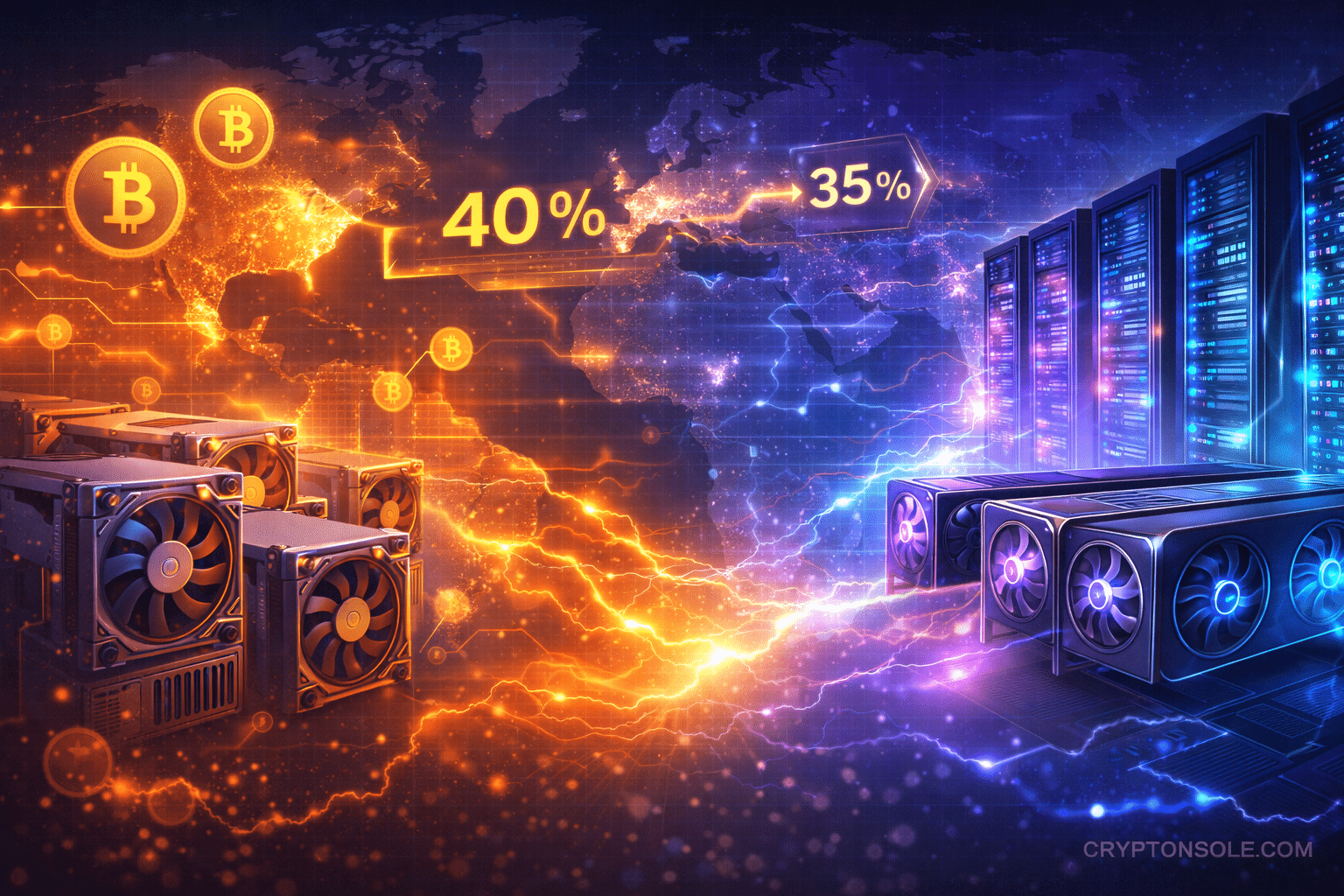
North American Bitcoin mining pools saw their share of newly mined blocks decline from over 40 % at the start of 2025 to approximately 35 % by year’s end, according to a bitcoin mining industry analysis by BlocksBridge Consulting. The shift comes as major mining firms increasingly diversify into artificial intelligence (AI) and high-performance computing (HPC) infrastructure, reshaping the landscape of regional mining dominance.
Mining share decline amid strategic pivots
BlocksBridge Consulting data show that the combined block share of leading North American mining pools — including Foundry USA, MARA Pool and Luxor Technologies — slipped through 2025 even as total global hashrate grew significantly. At the beginning of the year, these pools were responsible for more than 40 % of all Bitcoin blocks mined; by December, that proportion had fallen to around 35 %.
Industry analysts attribute the shift to a broader strategic realignment among mining operators. As Bitcoin mining profitability has faced headwinds from rising network difficulty, higher energy costs and lower mining revenues, several large companies have begun repurposing power infrastructure for AI compute workloads, cloud hosting and HPC services — often commanding higher per-megawatt economics than traditional ASIC mining.
For example, recent sector reporting shows miners evaluating alternative revenue sources as traditional hashprice compression stretches payback periods on new Bitcoin miners and bolsters demand for diversified workloads such as GPU-based AI hosting.
What’s driving the pivot to AI
Heightened enterprise demand for AI and HPC capacity is drawing capital and infrastructure away from pure Bitcoin mining. Firms like Cipher Mining and others have publicly highlighted that AI hosting now represents a growing portion of their data center utilization and revenue, with some operations dedicating a majority of capacity to AI workloads.
In parallel, energy and data center real-estate strategies increasingly prioritize long-term contracted revenue from AI clients, which can offer steady income streams compared with the volatile economics of mining rewards and transaction fees — especially in periods of high hashrate growth or flat Bitcoin pricing.
Implications for the mining ecosystem
Regional share and competition
While North America remains a major hub for Bitcoin mining, its declining share reflects intensifying competition from other regions and industry diversification. Energy build-out and cost dynamics in field like China and Central Asia also influence block share outcomes by shifting where hashpower is most cost-efficiently deployed.
Network security and decentralization
A more geographically balanced distribution of mining pools could support Bitcoin’s decentralization, but the shift driven by economic incentives — rather than purely technical or ideological reasons — underscores how mining share can fluctuate with broader tech trends and commercial priorities.
Business model evolution
The trend highlights a larger evolution: miners are increasingly multi-service infrastructure providers rather than strictly proof-of-work operators. This can open new revenue lines but may also dilute focus on mining itself if the economics of AI and cloud services continue to outperform Bitcoin mining returns.
What to watch next
- Hashrate trends and mining profitability: Tracking whether ASIC mining economics improve in 2026 as BTC price and fees evolve.
- AI and HPC service adoption: The extent to which AI workload hosting boosts overall miner revenues and attracts fresh investment.
- Regional mining dynamics: Whether shifts in energy capacity and regulation further redistribute mining share globally.
- Infrastructure reinvestment: How companies balance capital expenditures between Bitcoin mining and high-performance compute build-outs.
Bottom line: The drop in North American Bitcoin mining block share — from roughly 40 % to 35 % in 2025 — reflects a strategic industry shift. Miners are increasingly diversifying into AI and high-performance computing uses for their energy and data center capacity, reshaping traditional mining dominance even as Bitcoin’s global hashrate continues to climb.