







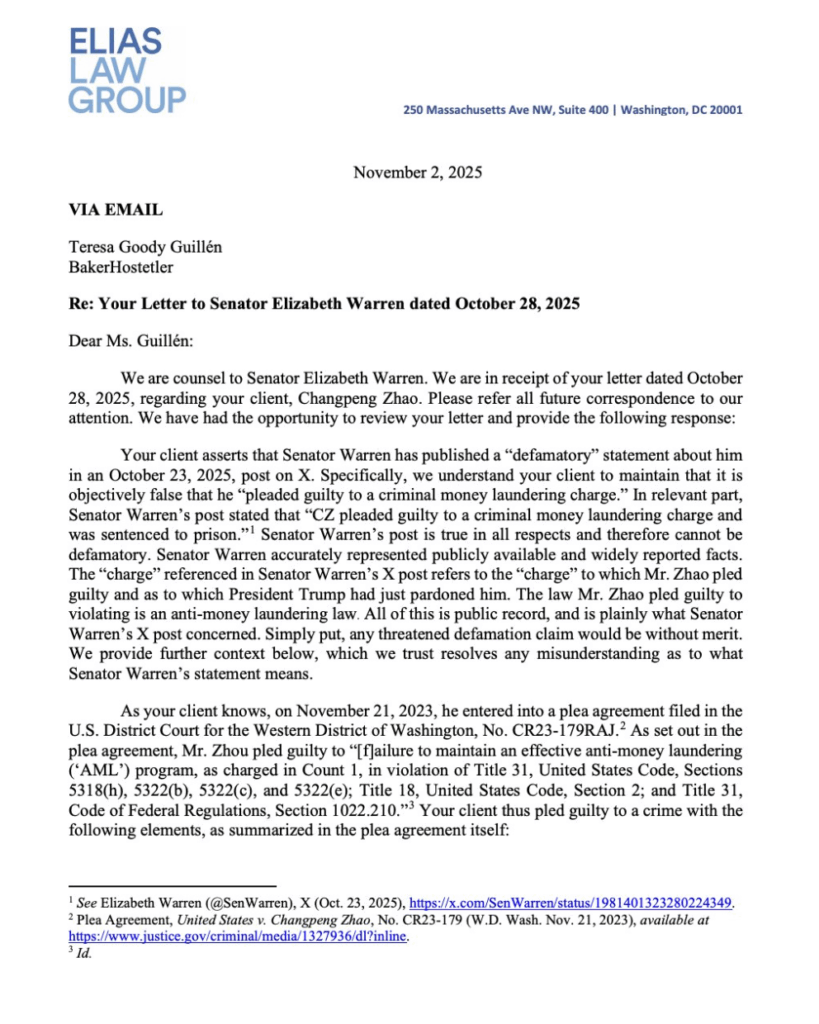
Senator Elizabeth Warren’s lawyers have responded to defamation threats from Binance founder Changpeng “CZ” Zhao, stating any such claim would be “without merit” and emphasising that her public remark concerning his conviction was grounded in publicly-available records.
What triggered the dispute
- On October 23, Senator Warren posted on X (formerly Twitter): “CZ pleaded guilty to a criminal money laundering charge and was sentenced to prison.”
The post followed President Donald Trump’s pardon of Zhao. - Zhao’s legal counsel, led by attorney Teresa Goody Guillén, responded by alleging the statement was false and defamatory — arguing that Warren mischaracterised the nature of Zhao’s conviction. They sought a retraction.
- In response, Warren’s attorney, Ben Stafford, sent a letter stating: “Simply put, any threatened defamation claim would be without merit.”
The letter argued Warren’s statement echoed the language used in the U.S. Department of Justice’s communications, making it fact-based and therefore protected.
Legal framing & defence basis
- The defence emphasises the statement was based on official DOJ documentation and court records describing Zhao’s conviction under the Bank Secrecy Act (BSA). They argue the senator’s post contains accurate factual information.
- Under U.S. defamation law, public-figure defendants must show the speaker made a false statement with “actual malice” — i.e., knowing it was false or recklessly disregarding the truth. The defence argues that because the statements are substantiated by public record, this standard cannot be met.
- The letter also states: “Her X Post does not state — and should not be construed to state — that he pled guilty to any other money laundering charge.”
This framing seeks to limit interpretation of the original post and reinforce its narrow factual basis.
Broader implications
- Free speech vs reputational harm: The case highlights how public officials’ commentary on high-profile individuals overlaps with First Amendment protections and defamation thresholds.
- Crypto-industry scrutiny: Because Zhao is a prominent figure in the crypto ecosystem and the post ties to his pardon, the dispute raises questions about public-figure commentary on digital-asset founders and regulatory oversight.
- Legal precedent for digital-asset dialogue: If the matter proceeds, courts may grapple with how statements about crypto executives and regulatory outcomes are treated under existing defamation doctrine, potentially shaping future commentary dynamics.
- Political signalling: Senator Warren’s comments (and defence thereof) reiterate her critique of crypto industry regulation and enforcement, especially in the context of large exchanges and senior founders.
What to watch next
- Zhao’s next move: Will Zhao actually file a lawsuit? If so, the pleadings and venue choice (state or federal) will be key signals of escalation.
- Court filings: Any filed complaint or motion may reveal deeper details — e.g., highlighted unfair statements, requested damages, or defence motion papers — which could further clarify how crypto figures are treated legally.
- Media strategy: Because this involves public-figure comments, media and social-platform amplification may influence how the statement is perceived and how both sides position themselves.
- Industry commentary and regulation: Regulatory actors (SEC, DOJ) and crypto-industry stakeholders may issue statements or reflect on the episode, particularly as it touches on exchange regulation, AML enforcement and crypto-founder accountability.
Bottom line
Senator Warren’s legal team has firmly rejected Changpeng Zhao’s defamation threat, framing her post as a fact-based comment aligned with public records and protected under free-speech standards. The dispute pits crypto-industry leadership, high-level political commentary and public-figure defamation law into a highly visible intersection. While a lawsuit is not yet confirmed, the outcome could influence how regulatory-linked commentary on crypto founders is handled going forward.
6LB0F8R9