






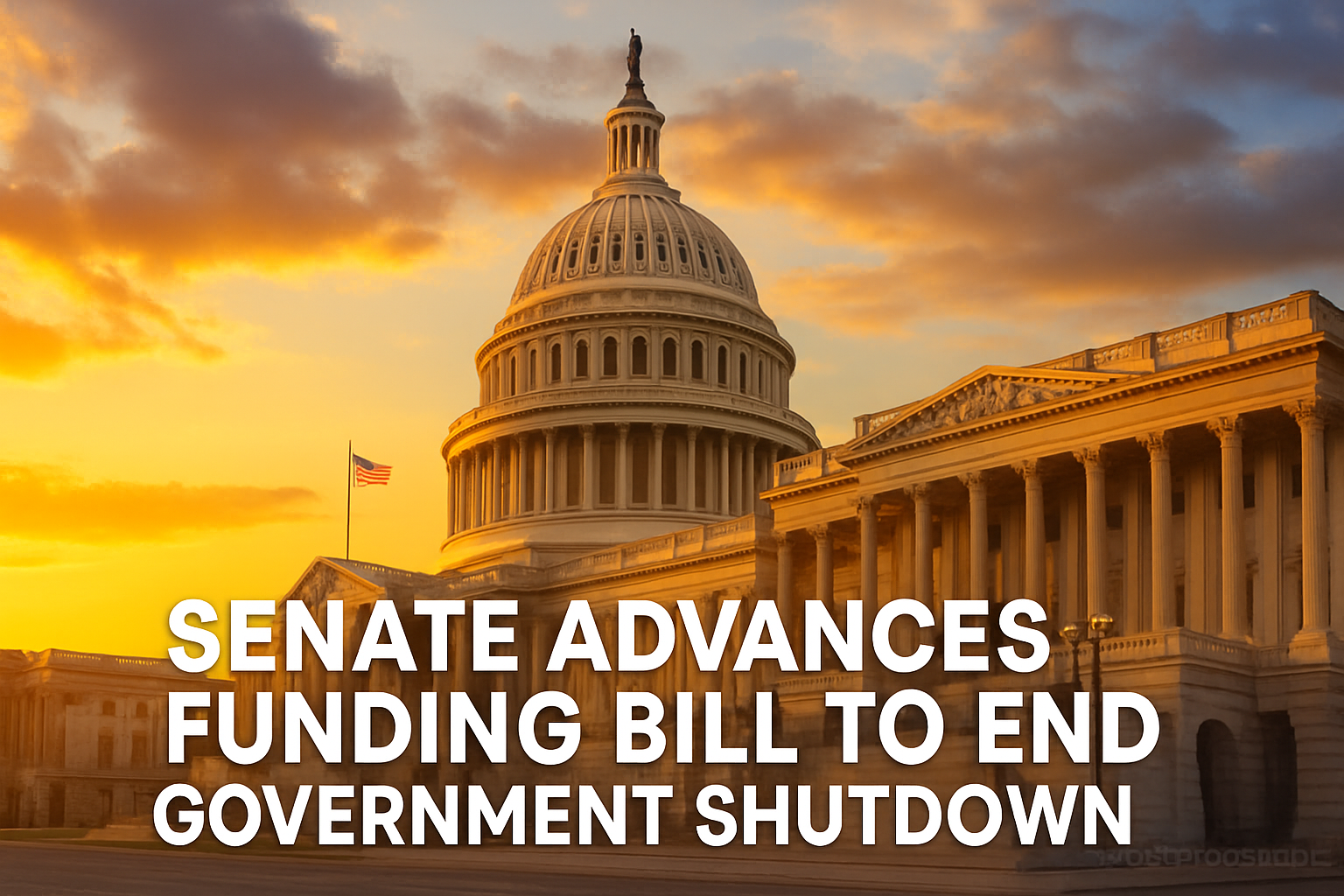
The United States Senate today cleared a major procedural hurdle in ending the ongoing federal government shutdown by approving a bipartisan funding resolution in a 60-40 vote. The action moves the bill one step closer to reopening the government, reversing federal worker layoffs and restoring essential services — though significant political obstacles remain in the United States House of Representatives and with the President.
The vote and what it entails
In a Sunday session, senators voted 60 to 40 to invoke cloture — effectively breaking a filibuster and advancing the funding bill. Eight Democrats joined all Republicans in backing the measure.
The funding resolution reauthorises government spending for most federal operations through late January 2026, guarantees retroactive pay for furloughed and still-working federal employees, and reverses layoff notices issued during the shutdown.
However, it does not extend premium tax credits under the Affordable Care Act (ACA) — a key demand of many Democrats. The bill instead gives a guaranteed vote in December on those credits, but no automatic extension.
Why the breakthrough matters
The vote is significant because it is the first time in the shutdown that the Senate has mustered the 60-vote threshold needed to advance funding legislation. Previous efforts failed multiple times.
The shutdown, which began after funding lapses on Oct. 1, had stretched for more than five weeks by early November, affecting federal employees, services, and economic activity.
The bill restores basic operations and signals bipartisan senators were willing to compromise to reopen the government — even without immediate agreement on healthcare subsidies. This puts pressure on the House to act and the President to sign the measure.
Political divide and remaining hurdles
Despite advancing in the Senate, the measure faces substantial headwinds:
- Many House Democrats oppose the bill, objecting to the absence of ACA tax-credit extensions.
- Senate Democratic leadership, including Chuck Schumer, voted against advancement, arguing the compromise falls short on healthcare.
- Even after Senate passage, the bill still requires House approval and presidential signature — timing and amendments could delay the full reopening.
Impact on federal workers and programs
- The bill ensures retroactive pay for the roughly 2.5 million federal employees affected by the shutdown.
- It prevents further layoffs at least through the funding-extension period.
- Critical services tied to the federal government — food assistance, air travel, regulatory applications — may begin to recover as funding clears. The shutdown had caused thousands of flight cancellations and service disruptions.
- The healthcare subsidies question remains unresolved; if not extended, millions of Americans could face higher premiums starting in 2026.
Looking ahead
Key items to watch:
- Whether the House passes the funding measure and sends it to the President for signature — reopening could happen this week if all aligns.
- Whether the promised December vote on ACA premium tax credits leads to actual extension or becomes a protracted negotiation pivot.
- The full-year appropriations process: Once the short-term resolution passes, Congress must still debate and pass comprehensive spending bills for 2026.
- Political fall-out: Senators who broke with their party may face primary challenges; the length of the shutdown and its economic impact could influence mid-term election narratives.
Bottom line
By clearing the 60-vote threshold in the Senate, lawmakers moved a decisive step toward ending the longest U.S. government shutdown to date. The measure offers relief to federal employees and a path back to operations, but the deal remains incomplete — particularly on healthcare subsidies and House approval. Reopening hinges now on swift House action and presidential assent.
55ZIAWGO